
Batch Filtering Centrifuges vs. Agitated Nutsche Filter-Dryers (ANFD)
G-force (bowl speed 1080 RPM at 48” diameter = 800 G’s)
Higher G’s accelerates filtration and deliquoring but increases attrition risk and can compress marginal cakes. Usually the G-force ranges from 800-1200.
A Technical White Paper on Solid–Liquid Separation Technology Selection in Pharmaceutical-Chemical Manufacturing
Vertical Basket • Horizontal Peeler • Inverting Filter Centrifuge (IFC) • ANFD
1. Introduction
Separating crystallized solid particles from mother liquor — and then washing and drying that solid to specification — is one of the most consequential unit operations in a pharmaceutical-chemical (“pharma-chem”, or bulk pharmaceutical chemical / BPC and API) process train. Two families of equipment dominate batch operation in this space: the batch filtering centrifuge (in vertical basket, horizontal peeler, and inverting filter centrifuge configurations) and the Agitated Nutsche Filter-Dryer (ANFD). This paper defines both technology families, reviews the process parameters that govern filtration performance, and lays out the practical decision criteria — flux rate, cake thickness, wash chemistry, containment, and drying requirements — that determine which technology wins for a given slurry system.
2. Batch Filtering Centrifuges — Definition and Types
A batch filtering centrifuge separates solids from a slurry by feeding the slurry into a rotating basket lined with a filter medium (usually polypropylene or felt). Centrifugal force drives the mother liquor through the accumulating solids bed and the perforated basket wall, while solids build up as a cake on the inside of the filter media lining the basket. A typical batch cycle is: feed → cake formation/filtration → wash (one or more stages) → spin/deliquoring → cake discharge → basket wash-down. Relative to gravity or vacuum filtration alone, centrifugal g-force substantially accelerates both liquid removal and residual-moisture reduction. The filter medium in these machines is almost never metal cloth — it is typically a woven synthetic “cloth,” most commonly polypropylene, with PTFE (Teflon) used where a sticky or crystal-adherent cake needs better release, or felt where the crystals are needle shaped.
2.1 Vertical Basket Centrifuge
Vertical axis, slurry loaded from the top into a basket that sits on (or is suspended from) the drive shaft. Discharge is typically by a scraper/plough operating at reduced speed. The drive can be positioned either above the basket (top-driven, as in the classic Mark III design) or below it (bottom-driven, as in Tolhurst and many other designs — generally the preferred arrangement because it is more stable and keeps the drive and seals clear of the product zone and simplifies top-loading). Vertical baskets are mechanically simple, rugged, handle a wide range of particle sizes, and can be fully enclosed for containment. Their main drawback is a slower, more discharge-limited cycle, and they are more prone to vibration than horizontal machines if the cake is not evenly distributed around the basket.
Regional footprint: vertical basket centrifuges historically dominated North America, which is why they are conventionally sized in inches — common basket diameters include 32″, 36″, and the workhorse 48″ × 30″ basket (about 16 ft³ of cake capacity at a 7″ cake depth), up to the largest common size, a 60″ × 30″ basket (about 30 ft³ of cake capacity).
2.2 Horizontal Peeler Centrifuge
Horizontal axis; a peeler knife shaves the cake off the basket wall while the basket is still spinning at reduced speed, enabling fast, largely automated discharge. This gives the shortest cycle times and highest throughput of the three centrifuge types, making it a workhorse for large-volume BPC production. The tradeoff is mechanical shear from the peeling action, which can cause particle attrition or fines generation — not ideal for fragile or friable crystals. Horizontal peelers historically originated and dominated in Europe, which is why they are conventionally sized in millimeters — common basket diameters include 630 mm, 800 mm, 1000 mm, 1250 mm, and 1600 mm (with some suppliers offering baskets up to 2000 mm). Mechanically, horizontal machines run smoother than vertical baskets — much like a front-load home washing machine versus a top-load unit — because the rotating mass and cake are better balanced along a horizontal axis.
2.3 Inverting Filter Centrifuge (IFC)
In an IFC, the filter cloth (mounted as a bag inside the basket) inverts inside-out to gently roll the cake off the basket without a mechanical blade contacting the product. This is much gentler than peeling — better suited to fragile crystals, sticky cakes, or shear-/attrition-sensitive crystal habits and polymorphs — while retaining the speed advantage of centrifugal filtration. Because the IFC basket is a closed, pressure-tight vessel, it also enables full containment through discharge, which matters for potent or genotoxic compounds. The IFC was pioneered by Heinkel, the German company (originally a WWII-era aircraft manufacturer) that pivoted into filtering-centrifuge design and engineering in the 1960s–70s and introduced the first IFC around 1980.
Pressure-Aided Centrifugation (PAC)
PAC — Pressure Added (or Aided) Centrifugation — is a feature unique to the IFC, originating with Heinkel. Because the IFC basket is a sealed, pressure-tight vessel, an additional step can be applied after filtration and wash are complete: a gas overpressure is applied above the cake surface, driving residual liquid through the cake and filter medium in addition to centrifugal force. In certain API chemistries, PAC can push residual cake moisture (LOD) well below 1% — approaching or matching what an ANFD drying step would achieve — without leaving the sealed IFC vessel. This is one of the more compelling reasons an IFC-with-PAC is evaluated directly against an ANFD in process design, rather than only against a plain peeler or basket centrifuge.
3. Process Parameters That Govern Centrifuge Filtration Performance
Filtration rate and cake quality in a centrifuge are governed by slurry and particle properties, and by how the machine handles them:
Parameter
Effect on Filtration
Solids concentration in feed slurry
Higher solids loading builds cake faster per unit time but raises hydraulic resistance sooner; too dilute a slurry wastes cycle time on liquid throughput with little cake build.
Particle size / PSD
Larger, narrower-distribution particles give higher cake permeability and faster filtration. Fines (especially sub-10 micron) blind the cake and filter medium, sharply raising resistance.
Particle shape / crystal habit
Needle- or plate-like crystals often pack into open but sometimes fragile cakes; equant/cubic crystals typically pack denser but more uniformly and filter predictably.
Cake compressibility
Rigid crystals resist compaction under g-force; soft, gelatinous, or amorphous solids compress under centrifugal load and choke filtration (think flat corn-flakes versus round marbles).
Mother liquor viscosity / temperature
Higher viscosity slows flow through the cake; warming the slurry (where chemically acceptable) can improve filtration rate.
G-force (bowl speed 1080 RPM at 48” diameter = 800 G’s)
Higher G’s accelerates filtration and deliquoring but increases attrition risk and can compress marginal cakes. Usually the G-force ranges from 800-1200.
Filter medium resistance / pore size
Must retain product while avoiding excessive resistance or blinding.
3.1 Flux Rate — The Key Sizing Metric
The single most important sizing parameter for comparing these technologies is flux rate — filtrate throughput expressed as gallons per minute per square foot of filtration area (GPM/ft²). As a rule of thumb (not a hard boundary), a batch filtering centrifuge can handle slurries with a flux rate as low as roughly 3–5 GPM/ft², and because flux rate drops off as cake thickness increases, centrifuges are typically operated with a cake depth under 6″ (150 mm). An ANFD, by contrast, generally requires a better-filtering slurry — a flux rate of 5+ GPM/ft² — and the ability to build a cake of 6″ or more to justify its cost. This is the crux of the technology-selection decision described in Section 5.
3.2 Cake Stratification
The main filtration-related drawback of a centrifuge relative to an ANFD is the possibility of cake stratification: particles segregate by size during centrifugal cake formation and settle into distinct layers, much like the layers in a baked cake. Stratification can slow filtration (fine layers blind faster) and reduce wash efficiency, since wash liquor preferentially channels through coarser layers and bypasses fines-rich zones. Stratification is not an issue in an ANFD because filtration can be carried out with the agitator in slow motion, which keeps particles suspended and prevents them from segregating by size as the cake forms. Of course cake-channeling in the thick ANFD cake could become an issue especially during washing, but that is usually handled by reverse rotation of the agitator and pressing down on the cake to smoothen out the channels.
3.3 Static vs. Dynamic Washing
Wash method is another point of differentiation. An ANFD can provide both a static wash (aka ‘plug-flow’ wash where wash liquid added and allowed to displace through a stationary cake, exactly as in a centrifuge) and a dynamic wash (the agitator reslurries/resuspends the cake in wash liquid before re-filtering) — and can alternate between the two as many times as the chemistry requires. A conventional batch filtering centrifuge can only provide a static, displacement-style wash. One exception exists: a horizontal design called a siphon peeler centrifuge can perform a dynamic-style wash, but it is a specialized, lesser-known machine that most end users neither know about nor want to be bothered with in routine operation. This wash flexibility — the ability to fully repulp a cake to reach deep into agglomerates or break up channeled/stratified layers — is a distinct advantage for the ANFD in API chemistries where impurity or residual-solvent specs are tight.
3.4 Typical Performance Outcomes for Centrifuges
- Cake thickness — Cake thickness: roughly 20–150 mm (under 6″ to 7” or 150 to 175 mm) depending on machine type and flux rate — vertical baskets and peelers tend toward the thicker end, IFCs somewhat thinner in the 4” range, since the whole cake must invert cleanly off the bag.
- Wash efficiency — Wash efficiency: static/displacement washing, typically 1–3 cake-volumes of wash liquor per stage, provides good mother-liquor displacement provided the cake stays crack-free; efficiency drops if the cake channels or is stratified.
- Cake moisture —
Cake moisture after spin: typically 5–15% w/w residual liquid heel — good compared to plain filtration, but well above the sub-1–2% LOD usually required for a finished, dry API or intermediate (unless PAC is used in an IFC).
4. Why ANFD Is the Natural “Technology Twin” for Comparison
Both a filtering centrifuge and an ANFD answer the same fundamental question in a pharma-chem process train: how do you separate crystallized solids from mother liquor, wash out impurities or residual solvent, and hand off a well-defined solid? Both can be fully enclosed for containment, both handle batch crystallizations typical of API and intermediate manufacturing, and both are routinely evaluated head-to-head at the process-design and tech-transfer stage because they solve overlapping duty with very different strengths — one optimized for filtration speed, the other for combining filtration and drying in a single vessel. Because the choice affects capital equipment count, cycle time, containment strategy, and product-quality risk simultaneously, it is one of the more consequential unit-operation decisions in solids process design.
5. ANFD: Definition and Operation
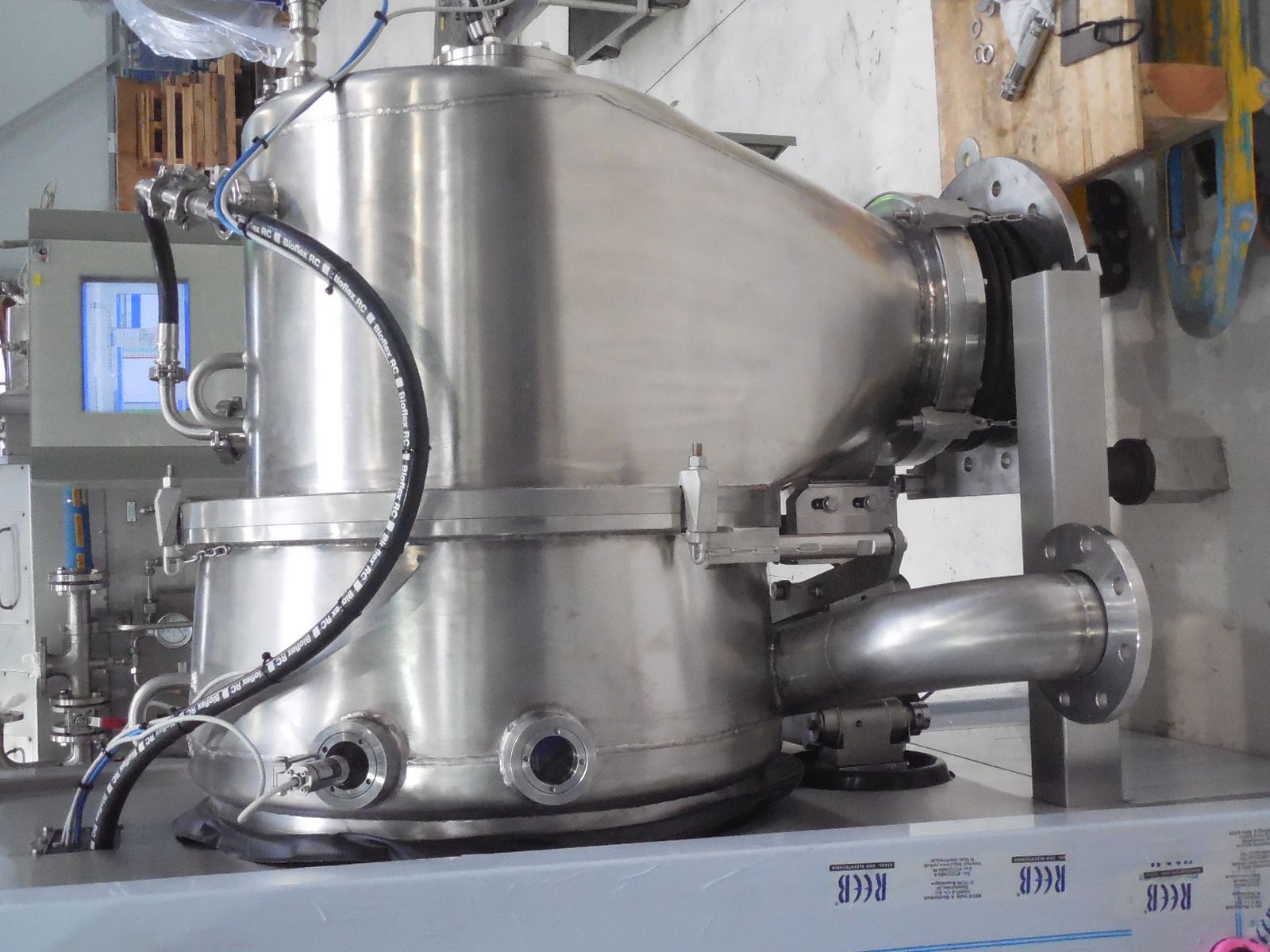
An Agitated Nutsche Filter-Dryer (ANFD) is a single, jacketed, closed vessel with a porous filter plate (or filter cloth or sintered metal mesh, on a plate) at the bottom and a top-mounted, retractable agitator — usually 2-blade S-anchor or paddle style, often fitted with wall- and bottom-scraper blades. It performs the entire filtration, wash, and drying sequence in one vessel, without transferring the wet cake elsewhere:
- Filtration — Slurry is charged; vacuum below the filter plate (or pressure above) pulls mother liquor through the cake and filter media.
- Wash / reslurry — Wash solvent is added; the agitator can reslurry (resuspend) the cake for thorough impurity removal, then re-filter — repeated as needed, alternating static and dynamic washing as described in Section 3.3. Static wash has its advantages because the particle being washed does not move versus dynamic wash (more on wash efficiencies in a future article).
- Deliquoring — Vacuum and/or mechanical pressing by the agitator squeezes out residual liquid.
- Drying — The jacket (and often the agitator also) is heated and vacuum applied while the agitator tumbles the cake over against the side walls, breaking it into granules to improve heat transfer and driving off solvent down to a target LOD — producing a finished dry powder in the same vessel. (The heated agitator, while adding just about 5% to the heated surface area, has an oversize impact on drying performance, more on this in a later post).
ANFDs are also frequently built in exotic, corrosion-resistant metallurgy — for example Hastelloy C22 — when the mother liquor contains aggressive species such as chlorides (e.g., HCl). This metallurgy, combined with the vessel's pressure/vacuum rating and integral jacket, makes the ANFD an expensive piece of equipment: a 1 m² filtration-area unit can easily run into seven figures (USD).
6. When ANFD Competes With or Beats a Centrifuge / IFC-with-PAC
Favors ANFD
Favors Centrifuge / IFC (with or without PAC)
Slurry has a good flux rate (rule of thumb: 5+ GPM/ft²) and can build a cake of 6″ (150 mm) or more — needed to justify the capital cost.
Flux rate is more modest (roughly 3–5 GPM/ft²); centrifugal force still gives a large, real filtration-rate advantage over vacuum-only filtration even with a thinner cake.
Slurry filters poorly, is compressible, or fines-laden — but is still processed because the ANFD's drying step, not its filtration speed, is what's being bought.
Cake is prone to stratification-sensitive impurities where the process can tolerate a static-only wash, and cycle time/throughput matters more than repulp flexibility.
Need a finished dry powder (sub-1–2% LOD) without a second drying vessel — avoids extra powder transfer, exposure, and cross-contamination steps.
Downstream process tolerates a wetter cake, or the wet cake feeds a separate, more thermally efficient dryer (e.g., fluid bed) sized for higher throughput — or an IFC with PAC drives LOD low enough without a separate dryer.
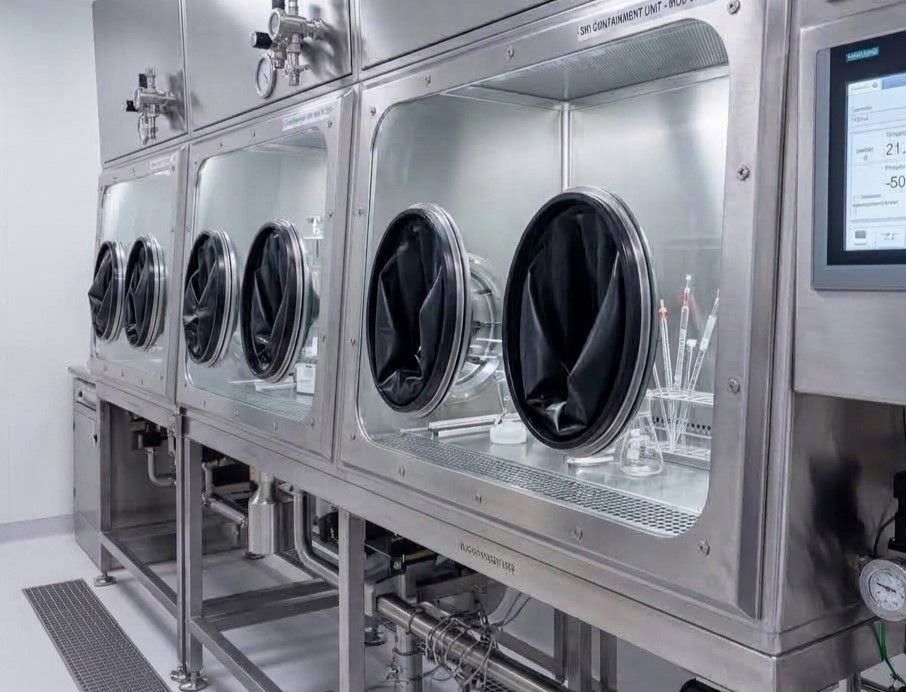
High-potency/genotoxic API where minimizing open transfers and maximizing single-vessel containment is the priority, and dynamic (reslurry) washing is needed to hit tight impurity specs.
Containment is still achievable via isolators or a sealed IFC basket (with or without PAC), but campaign throughput and $/kg processed matter more.
Mother liquor viscosity / temperature
Higher viscosity slows flow through the cake; warming the slurry (where chemically acceptable) can improve filtration rate.
Cohesive/sticky cakes that will not discharge cleanly from a centrifuge basket, even via inversion.
Free-flowing cake that discharges cleanly (peeler) or inverts cleanly (IFC); large campaigns favor a peeler's fast, automated discharge.
Smaller batch sizes where one flexible vessel (filter + wash + dry) is more capital-efficient than a centrifuge plus a separate dryer train.
Larger-scale, established campaigns where combined centrifuge + dedicated-dryer throughput beats the ANFD's inherently slow, conduction-limited drying step.
The key trade-off: an ANFD's drying step is usually its bottleneck — heat transfer relies on conduction from the jacket through an agitated powder bed, which is slow, especially for thick cakes or large batches, and can stretch a batch to many hours or even days. A centrifuge (especially a peeler) filters and deliquors much faster but leaves a wetter cake that still needs a separate, dedicated dryer to reach pharma-grade LOD — unless PAC in an IFC closes that gap. Whether that trade is worth it depends on filterability (flux rate), potency/containment requirements, and campaign scale — which is why this comparison is done slurry-by-slurry rather than by defaulting to one technology across a whole process train.
7. Leading Equipment Suppliers (Western Hemisphere)
Many of the historic nameplates below have since been absorbed into larger process-equipment groups — notably Andritz and De Dietrich Process Systems — but the names remain in common industry use for machine type and heritage:
Equipment Type
Historic / Current Suppliers
Vertical basket centrifuge
Tolhurst, Mark III, Ketema, Western States, Robatel, Krauss-Maffei, Thomas Broadbent (UK)
Horizontal peeler centrifuge
Krauss-Maffei (now part of Andritz), Robatel (notably up to 2000 mm baskets), Bachiller (Spain)
Inverting Filter Centrifuge (IFC)
Heinkel (inventor of the IFC, and of PAC), Comi Condor (now Comi Polaris)
Agitated Nutsche Filter-Dryer (ANFD)
Rosenmund (now DeDieterich), Mavag (now Pfaudler), 3V Cogeim, Comber (now DeDieterich).
8. Conclusion
Batch filtering centrifuges and ANFDs are close technology twins that both filter, wash, and prepare API or intermediate solids from mother liquor — but they are optimized for different points on the filterability spectrum. Centrifuges win where flux rate is moderate, cake depth stays under about 6″/150 mm, and a separate dryer (or an IFC with PAC) can economically finish the drying job. ANFDs win where the slurry filters well enough to build a thick, high-flux cake, where dynamic reslurry washing is needed to meet impurity specs, and where delivering a single-vessel, fully contained, finished dry powder outweighs the ANFD's higher capital cost and slower, conduction-limited drying step. The right answer is almost always slurry-specific, which is why side-by-side flux-rate and cake-thickness testing on the actual process stream remains the deciding factor in technology selection.
Recent Posts