
Honey, I Shrunk the Batch!
G-force (bowl speed 1080 RPM at 48” diameter = 800 G’s)
Higher G’s accelerates filtration and deliquoring but increases attrition risk and can compress marginal cakes. Usually the G-force ranges from 800-1200.
How Two Pharma Revolutions Are Really One Story.
For most of the twentieth century, a pharmaceutical capital equipment sale had a predictable shape. A customer needed a glass-lined reactor, and the sweet spot — the size that made economic sense for a new API production line — sat comfortably at 2,000 to 3,000 (maybe 4,000) gallons. That assumption held for decades. For pharmaceutical API production specifically, it doesn't hold true anymore.
Today, when a pharmaceutical customer specs a new glass-lined reactor project — particularly one built around a highly potent compound — it's increasingly landing at under half that, or just about ~1,000 gallons, or less. The 2,000–3,000-gallon vessels that once defined the category are still being bought for pharma applications too, but mostly as replacements for equipment installed 40 or 50 years ago, not as the standard for new capacity. This isn't a universal shrinkage across every glass-lined reactor application, though: greenfield agrochemical and other specialty chemical projects, where the chemistry is typically bulk and non-potent, still routinely spec vessels at 2,000, 3,000, even 6,000 gallons, because scale economics still favor size when high-potency and containment aren't the driving constraint. The story here is specific to pharma, and more specifically to the high-potency-driven end of it. Having sold into these accounts for decades, I've watched the pharma sweet spot shrink in real time, and I've come to believe it's not really a story about reactor size at all. It's a story about potency, precision, and the shape of the pharmaceutical market itself — and it's a story that's now repeating, almost beat for beat, a generation later, in an entirely different part of the industry: biologics manufacturing.
Act I: When APIs Got Dangerous — and Small
The shift on the small-molecule side traces back to the rise of highly potent APIs (HPAPIs). By most industry definitions, an HPAPI is a compound active at a therapeutic daily dose of 10 mg or less — or with biological activity at roughly 150 μg per kilogram of body weight or below. That's a meaningfully different profile from a traditional bulk API, which is often dosed in the hundreds of milligrams to grams. Less active ingredient per dose means, quite simply, a smaller batch.
Two forces converge here. First, potency itself: a compound that works at 10 mg a day doesn't need the manufacturing volume that a gram-dose compound does. Second, and just as important, is who the drug is for. As therapies become more targeted — built around specific biomarkers, genetic profiles, or narrow patient populations — the total volume of product the world needs shrinks accordingly. This is a direct consequence of the shift toward personalized medicine, which is pulling volumes down and focus up across the industry.
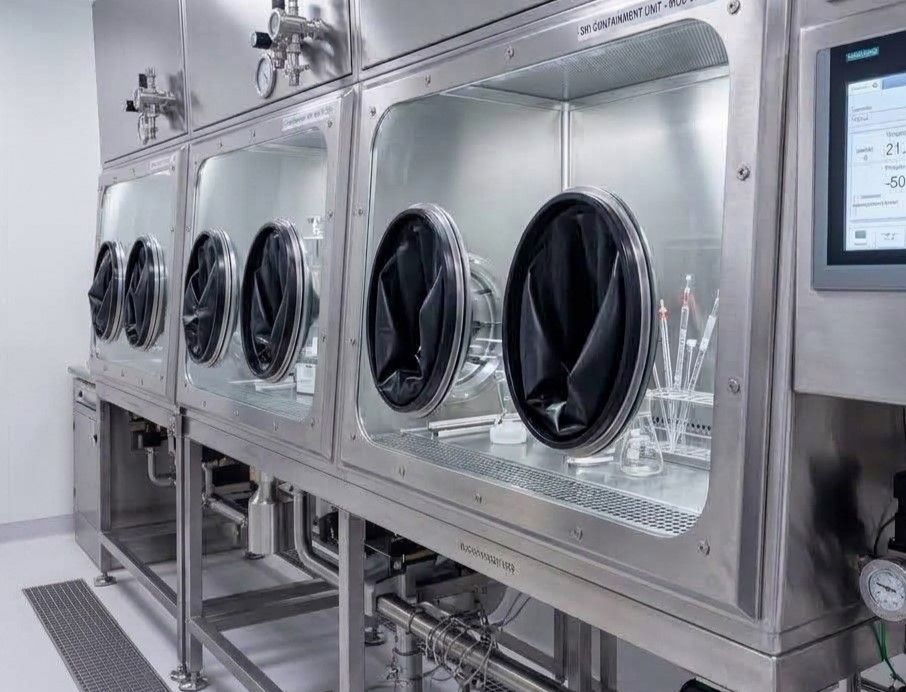
There's a third factor that's less discussed but just as real: containment economics. HPAPIs are classified by occupational exposure limits as low as 10 μg per cubic meter of air — orders of magnitude more stringent than a conventional API. Handling that safely requires negative-pressure environments, specialized air handling, and rigorous operator protection, and those costs scale with batch size. A smaller batch isn't just adequate for a potent, targeted compound; it's often the more economical, more containable choice.
The tell is in what pharmaceutical customers are actually specifying for potent-compound projects. New-build HPAPI reactor projects increasingly land under 1,000 gallons, while the old 2,000–3,000-gallon vessels get bought mainly to replace equipment that's been in service since the 1960s, 70s, or 80s — not to add new capacity. Elsewhere in the same industry — agrochem, specialty chemicals, non-potent bulk API — that older sweet spot is still very much alive.
Act II: The Blockbuster Model Breaks
While small-molecule batches were shrinking for potency reasons, biologics manufacturing was undergoing a parallel transformation for market-structure reasons.
At the turn of the century, the biologics landscape was dominated by a small number of players — Amgen prominent among them — producing a handful of blockbuster products, each needing to supply enormous global demand. That concentration justified the era's massive stainless-steel bioreactor farms: facilities running multiple 15,000-liter tanks, sometimes six or more at a single site, built to manufacture one molecule at truly massive scale.
That world is ending, and the data marks a real inflection point. In early 2026, biologics crossed 50% of the global drug development pipeline for the first time in industry history — a milestone reached after four decades of small molecules dominating R&D. Part of the forcing function is the patent cliff now bearing down on Big Pharma: between 2025 and 2030, roughly 190 branded drugs — nearly 70 of them blockbusters generating over $1 billion annually — will lose exclusivity, putting an estimated $180 to $300-plus billion in revenue at risk industry-wide. Facing that cliff, pharma R&D budgets have poured into biologics and targeted therapies precisely because they're harder to genericize — and every dollar chasing a narrower, more targeted biologic is a dollar not chasing the next blockbuster. The result: far more players, far more products, each serving a narrower slice of patients — fragmenting what was once concentrated demand across a much wider field of molecules.
Act III: The Chemistry Got Better Too
A third force compounds the first two, and it's worth keeping analytically separate: improvements in cell-line development and culture media have dramatically increased titers — the amount of product a given volume of cell culture can produce. In the early 1990s, monoclonal antibody titers ran roughly 0.05 to 0.1 grams per liter. Today, 3 to 10 grams per liter is commonly cited as standard, with some well-optimized processes reaching considerably higher. That's orders-of-magnitude improvement in less than a generation.
What that means in practice: the same output that once required a 15,000-liter stainless-steel tank can now, in many cases, come from a fraction of that volume. This is a distinct phenomenon from market fragmentation — one is about how much product the world needs, the other is about how efficiently you can make it — but the two forces point in exactly the same direction: smaller, more flexible manufacturing footprints.
Synthesis: What This Means for Equipment Makers
Put the three acts side by side and a clear pattern emerges: the pharmaceutical industry, across both its small-molecule and biologics halves, has spent the last generation-plus moving from a world of concentrated, high-volume production toward one of fragmented, flexible, right-sized manufacturing. The forces are different — potency and containment economics on one side, patent cliffs and personalized medicine on the other, titer efficiency compounding both — but the destination is the same.
For equipment OEMs, this isn't a footnote. It's a mandate to rethink the product line itself. A company built around one dominant “hero” vessel size is increasingly exposed; the winners are building modular platforms that flex across a range of scales, serving many smaller programs instead of one enormous one. This is precisely the logic behind today's single-use bioprocessing platforms, some now stretching to 5,000 and even 6,000 liters for customers who still need real commercial-scale volume — and it's the same logic that, a generation earlier, pushed glass-lined reactor makers serving the potency-driven segment of pharma toward smaller standard configurations and faster-turnaround custom builds, even as the broader specialty and agrochemical markets kept buying at the old scale.
It's also reshaping how this equipment gets sold. The catalog-selling era — “here is our biggest, most efficient standard vessel” — is giving way to something closer to consultative, customized, specification-driven selling: understanding a customer's specific molecule, containment needs, and campaign economics, and engineering toward that rather than toward a standard SKU. The equipment sale increasingly comes bundled with more service, more training, and more support for multi-product changeover, because the customer's own manufacturing reality is more diverse and more fluid than it used to be.
Author's Take: The Next 10 to 20 Years
The following is one practitioner's outlook, not a forecast — offered after decades of watching this pattern repeat, for what it's worth...
If the pattern holds, I'd expect the next decade to test just how far “smaller and more flexible” can go — toward genuinely patient-specific or small-cohort manufacturing, where a “batch” might one day mean a handful of doses rather than a commercial run. I'd expect modularity to stop being a selling point and start being table stakes — platforms designed from day one to be reconfigured, not replaced. And I'd expect the OEM landscape itself to fragment the way the drug pipeline has: fewer giants offering one dominant product, more specialized players building deep expertise in narrower niches. Or looked at another way, being nimble enough to customize every offering after a thorough understanding of the customer’s process.
None of that is certain. But the last generation suggests betting against fragmentation, in this industry, has been the losing bet.
Recent Posts