
The 4 Forces Driving Pharmaceutical Barrier Systems to the Next Generation
Synthesis: What This Means for Equipment Makers
Put the three acts side by side and a clear pattern emerges: the pharmaceutical industry, across both its small-molecule and biologics halves, has spent the last generation-plus moving from a world of concentrated, high-volume production toward one of fragmented, flexible, right-sized manufacturing. The forces are different — potency and containment economics on one side, patent cliffs and personalized medicine on the other, titer efficiency compounding both — but the destination is the same.
For equipment OEMs, this isn't a footnote. It's a mandate to rethink the product line itself. A company built around one dominant “hero” vessel size is increasingly exposed; the winners are building modular platforms that flex across a range of scales, serving many smaller programs instead of one enormous one. This is precisely the logic behind today's single-use bioprocessing platforms, some now stretching to 5,000 and even 6,000 liters for customers who still need real commercial-scale volume — and it's the same logic that, a generation earlier, pushed glass-lined reactor makers serving the potency-driven segment of pharma toward smaller standard configurations and faster-turnaround custom builds, even as the broader specialty and agrochemical markets kept buying at the old scale.
It's also reshaping how this equipment gets sold. The catalog-selling era — “here is our biggest, most efficient standard vessel” — is giving way to something closer to consultative, customized, specification-driven selling: understanding a customer's specific molecule, containment needs, and campaign economics, and engineering toward that rather than toward a standard SKU. The equipment sale increasingly comes bundled with more service, more training, and more support for multi-product changeover, because the customer's own manufacturing reality is more diverse and more fluid than it used to be.
G-force (bowl speed 1080 RPM at 48” diameter = 800 G’s)
Higher G’s accelerates filtration and deliquoring but increases attrition risk and can compress marginal cakes. Usually the G-force ranges from 800-1200.
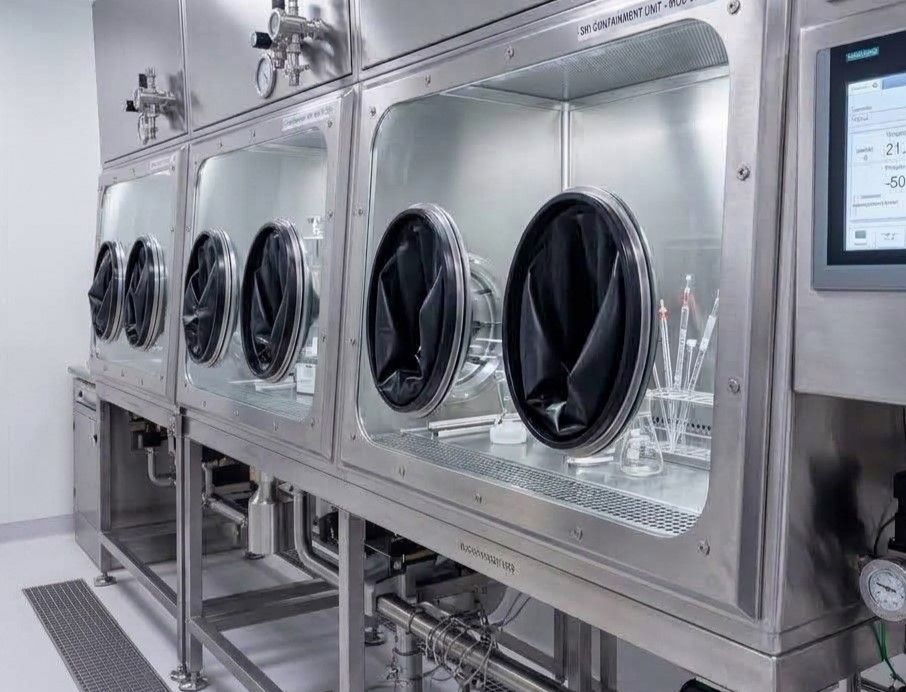
Pharmaceutical manufacturing has always been a fight against contamination, and equipment makers have always designed their barriers around it. Thirty years ago, that meant relatively simple positive-pressure enclosures that kept contaminants out. Today's barrier systems must also keep the most potent molecules in, often at microgram exposure limits, for batches measured in grams.
Four technologies, each maturing over the past decade, are now reshaping how those barriers are designed.
Here they are in brief.
1. The Barrier Itself Goes Single-Use.
In multi-product HPAPI plants, cross-contamination and cleaning validation are major hurdles. Single-use flexible enclosures let you run a batch, then dispose of the contact barrier entirely, with no cleaning cycle to validate.
2. Robots Replace the Glove.
Every earlier generation separated the operator from the process but still put a human hand in a glove port. The logical endpoint is removing the operator from the critical zone altogether. Multi-axis robots inside isolators now handle denesting, filling, and capping without human intervention.
3. Pat Closes the Loop in Real Time.
Process Analytical Technology (PAT) has matured alongside modern sensors and IoT. In-line spectroscopy such as Raman or NIR, continuous particle monitoring and automated glove-integrity checks now feed live data from inside the closed line. Earlier generations relied on scheduled leak tests and end-of-batch review.
4. Facilities Become “Podular.”
A fixed, single-product cleanroom is a poor fit for a CDMO serving a dozen clients a year. The market is shifting toward prefabricated, self-contained cleanroom pods with their own HVAC, adding a secondary containment layer around HPAPI equipment.
Where This Is Heading
Together, these four forces are shaping what may become a fifth generation of barrier technology, built for smaller batches, higher potency and fast product changeovers.
Read the full article:
5G Barrier Technology: Honey, We Shrunk the Batch!
Planning a bio-pharma-chemical process train that requires containment or evaluating barrier options?.
Recent Posts