


Discover the four key market and technology forces driving the evolution of next-generation pharmaceutical barrier systems and manufacturing safety.
How Two Pharma Revolutions Are Really One Story. For most of the twentieth century, a pharmaceutical capital equipment sale had a predictable shape. A customer needed a glass-lined reactor, and the sweet spot — the size that made economic sense for a new API production line — sat comfortably at 2,000 to 3,000 (maybe 4,000) gallons. That assumption held for decades. For pharmaceutical API production specifically, it doesn't hold true anymore. Today, when a pharmaceutical customer specs a new glass-lined reactor project — particularly one built around a highly potent compound — it's increasingly landing at under half that, or just about ~1,000 gallons, or less. The 2,000–3,000-gallon vessels that once defined the category are still being bought for pharma applications too, but mostly as replacements for equipment installed 40 or 50 years ago, not as the standard for new capacity. This isn't a universal shrinkage across every glass-lined reactor application, though: greenfield agrochemical and other specialty chemical projects, where the chemistry is typically bulk and non-potent, still routinely spec vessels at 2,000, 3,000, even 6,000 gallons, because scale economics still favor size when high-potency and containment aren't the driving constraint. The story here is specific to pharma, and more specifically to the high-potency-driven end of it. Having sold into these accounts for decades, I've watched the pharma sweet spot shrink in real time, and I've come to believe it's not really a story about reactor size at all. It's a story about potency, precision, and the shape of the pharmaceutical market itself — and it's a story that's now repeating, almost beat for beat, a generation later, in an entirely different part of the industry: biologics manufacturing.
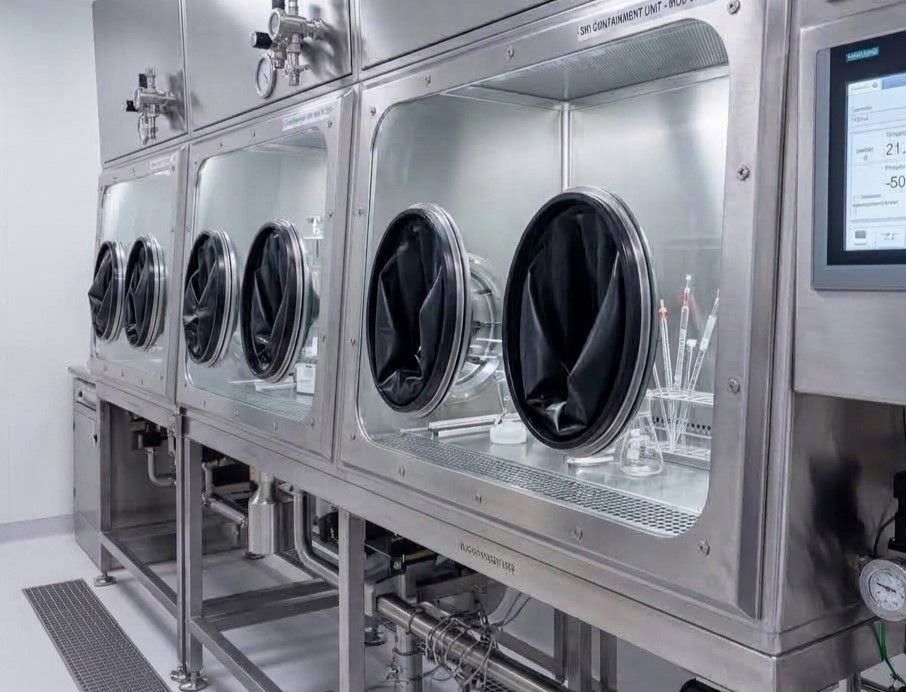
Explore the evolution of pharmaceutical barrier technology from 1st-gen RABS to 5th-gen single-use flexible isolators, robotics, and integrated PAT systems.